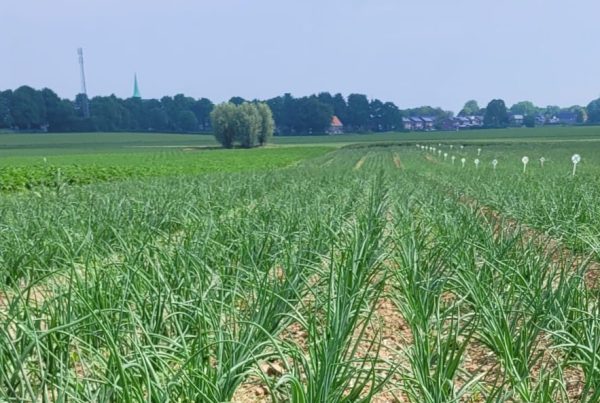

Can we grow onions with less nitrogen? That’s the question many growers have. NutriTrain went to investigate!
Goal of the trial: an average onion crop, with less nitrogen!
Construction: different objects, in three replicates, including control.
Three objects:
Object 1, detoxing:
Last season on our own trial we constructed a detoxing trial in the onions. The goal here was whether we could get the young onion plants to recover quickly from the violent impact of herbicide on the onions and their development.
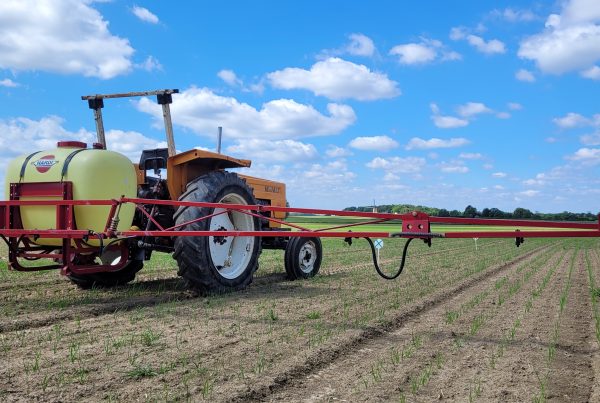
For this detoxing, we applied 1ltr RESIL® per hectare immediately after the last herbicide, followed by a second application of 1ltr RESIL® plus a little seaweed extract. The interval between the first and second sprays was 7 days.
Fulvic acid is often called nature’s transporter. Because our PFC 6.b CE certified fulvic acid is enormously small, it can easily penetrate cell walls. In addition, because of its small molecular size, it can axe many other elements.
Because of these features, which are unique to our RESIL®, the detoxing trial worked tremendously well.
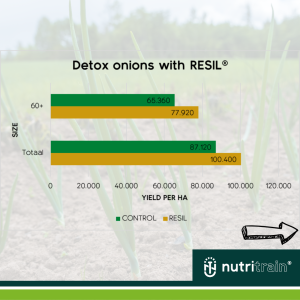
The result? 12.5 more tons of onions per hectare at 60+, see graph below!
Object 2, accelerate growth:
To get good and stable growth towards the longest day for onion, a schedule was set up with both REVIVE and REBOUND. This was started 10 days after the last herbicide application.
REVIVE takes care of overcoming stress by acting on the hormonal balance, so that free radicals (ROS) have no chance in the plant.
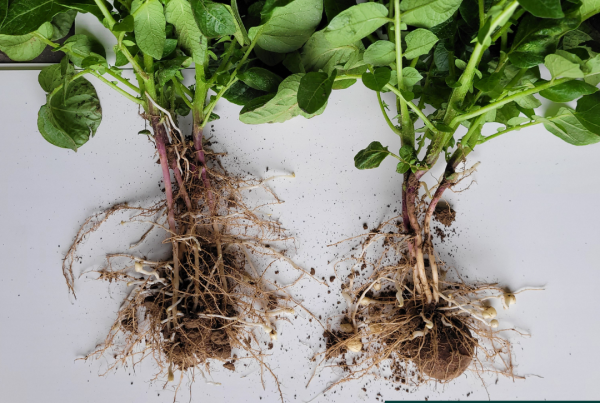
REBOUND contributes to a constant “boost” of cytokinins. This keeps the plant producing (hair) roots and growing root-dominant!
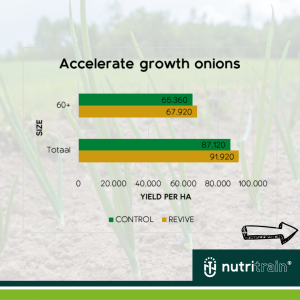
The result? 2 tons more onions per hectare at 60+, see graph below.
Object 3. Combination:
Within object 3, objects 1 and 2 were combined and applied one after the other.
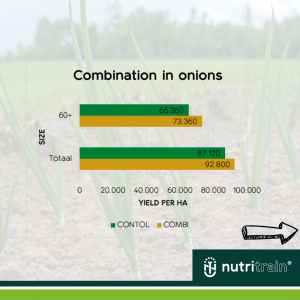
The result? 8 tons more onions per hectare at 60+, see graph below.
Final Result:
Detoxing your onions is extremely important to provide them the best possible way to develop!
This coming season, NutriTrain will continue studies. The 2025 trial will include several lower nitrogen levels, so we can find out where a possible limit lies.
Questions about this trial or curious about the possibilities within your own farm? Send us an email or give us a call! We are happy to help.